Shaun Dunn
 A lot of Edinburgh homeowners are asking themselves the same question just now: stick with a new boiler, or make the move to a heat pump? Fair question. Energy prices have been anything but calm, and nobody wants a heating bill that makes them wince every month.
The trouble is, most people start with the upfront cost, but that’s only part of the story.
The real cost of heating your home shows up over the next ten to fifteen years, and when you take that into consideration, the decision starts looking a lot different.
So, which is cheaper? It depends on what you mean by cheaper. Lowest cost today, or lowest running costs over time? A familiar system that heats your home quickly, or one designed to use less energy in the long run?
Once you understand how both systems actually work and what they are likely to cost over their lifetime, the boiler vs heat pump cost question gets a lot clearer.
How Boilers Work (Quick Overview)
Most homes in Scotland still use boilers, and there’s a reason for that. They’re familiar, widely available, and when they’re working well, they heat a home without much fuss.
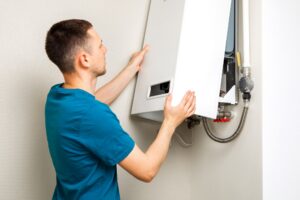
A standard boiler burns gas or oil to heat water, which then moves through your radiators or underfloor heating to warm the rooms. Simple enough.
Most boilers last around ten to fifteen years, depending on how well they have been looked after. But here is the part that catches people out: older boilers become less efficient as the years go on.
The boiler is still running, sure, but it needs more energy to produce the same heat. So even if you haven’t changed how you use your heating, the bills can still climb. It tends to happen gradually. Not dramatically, not overnight. Just steadily enough that you start to notice.
Boilers are reliable, no doubt about it. But they do wear down, and over time, that has a cost.
How Heat Pumps Work
Heat pumps cause a fair bit of confusion because they work in a completely different way. Instead of burning fuel to create heat, they take warmth that already exists outside and move it into your home. That heat can come from the air, the ground, or nearby water.
(And yes, there is still usable heat outside even on a cold Edinburgh morning. The physics works, even if it feels like they shouldn’t.)
Because of that, heat pumps can produce more heat energy than the electricity they use, which makes them one of the most efficient heating systems currently available. Government support may also be available to reduce installation costs, depending on which schemes are running and whether your property qualifies.
Someone fitting an air-source heat pump in 2026 will usually pay more up front than they would for a boiler. But once it is installed and set up properly, energy costs can come down meaningfully, and over time, those savings build.
A heat pump is not always a straight swap for a boiler. It is a different kind of system, and your home needs to suit it. But when it is the right fit, the long-term numbers are hard to argue with.
Comparing Costs: Installation vs Running
This is where the decision usually sharpens up.
Boilers are cheaper to install but can cost more to run over the years. Heat pumps are the opposite: more upfront, but usually cheaper to operate.
| System | Installation Cost | Running Costs | Maintenance | Lifespan |
| Boiler | £2,000–£4,000 | Higher, and often increases with age | Moderate | 10–15 years |
| Heat Pump | £7,000–£15,000 | Lower, due to high efficiency | Low to moderate | 15–20+ years |
Note: Figures are indicative UK averages for 2026. Actual costs vary by property, system, and installation. Get a quote for an accurate figure.
At first glance, the boiler looks like the obvious choice. You pay less to get it fitted, and your home is heated with a system you already know.
But when you look at energy bills across ten years or more, the picture shifts. A heat pump can often work out cheaper overall, especially in a well-insulated home. So the question is not just which system costs less. It is which cost you are trying to reduce: the upfront bill, or the monthly one.
There is not one right answer for every home. It depends on what you are prioritising at the moment and, let’s face it, what your house can handle.

Factors That Affect the Decision
Every home is different, so the right choice depends heavily on the property itself.
Size matters. Larger homes usually need more heating power, which affects both installation cost and running performance.
Insulation matters even more. A well-insulated home holds heat properly, which helps a heat pump work at its best. A draughty home loses heat quickly, which makes any heating system work harder than it should. That’s as true in an Edinburgh tenement with single-glazed windows as anywhere else.
Your current heating setup also plays a part. Replacing an old boiler with a new one is usually fairly straightforward if you already have radiators. A heat pump can work with radiators, but some homes need larger radiators or other upgrades to get the best out of one.
Underfloor heating, on the other hand, suits heat pumps well. It runs at lower temperatures, which is exactly what heat pumps prefer.
Government grants can change the calculation, too. Depending on eligibility and timing, current schemes can make a real difference to the upfront cost.
Then there is what you actually want from the system. Lower monthly bills? Long-term efficiency? A smaller carbon footprint?
A fairly simple way to look at it is this: if you have a three-bedroom house and it’s well-insulated, you’ll probably get your money back on a heat pump more quickly. But if your insulation isn’t very good, getting a new boiler might seem cheaper in the immediate future.
Hidden Costs Worth Knowing
This is the bit people often miss.
With boilers, the extra costs usually don’t arrive in one dramatic lump. They build slowly. As the boiler ages, repairs become more frequent, parts can be harder to find, and efficiency quietly drops away. That means higher bills, even before anything properly breaks.
Heat pumps have their own things to think about. To get the best from one, you may need larger radiators or improvements to your existing system. Depending on where the outdoor unit sits, you may need to check whether planning permission is required. Not always, but worth knowing upfront.
Energy prices matter too. Heat pumps run on electricity, and boilers on gas or oil. Neither system is fully protected from what happens in the energy market. Worth factoring in rather than assuming prices will stay where they are.
Making the Right Call
There isn’t a single perfect answer here.
Boilers are familiar, cheaper to install, and straightforward to manage in the early years. Heat pumps cost more upfront, but they can cut running costs and offer a lower-carbon way to heat your home over time.
The right choice comes down to your home, your budget, and how you want the costs to work over the next ten to fifteen years. And that’s exactly where a proper conversation helps.
At SD Plumbing & Heating, we give clear, honest advice on what actually suits your property, not just what is popular. We’ll walk you through the options, explain what each system would involve, and tell you which one makes the most sense for your setup. No jargon, no pressure, no steering you towards something that does not fit.
Give us a call or get a free quote online, and we’ll take it from there.